


1. Executive Summary & Intermodal Fleet Overview
In modern global supply chain logistics, the efficient movement of freight relies almost entirely on standardized intermodal transportation systems. Container shipping forms the backbone of international trade, but seamlessly transferring 20ft, 40ft, and 45ft ISO containers between ocean vessels, railway hubs, bonded depots, and final highway destinations requires high-performance road transport equipment. A professional container semi trailer is an engineered transport platform designed specifically to secure, support, and distribute the massive concentrated payloads of shipping containers during long-haul and short-haul transit.
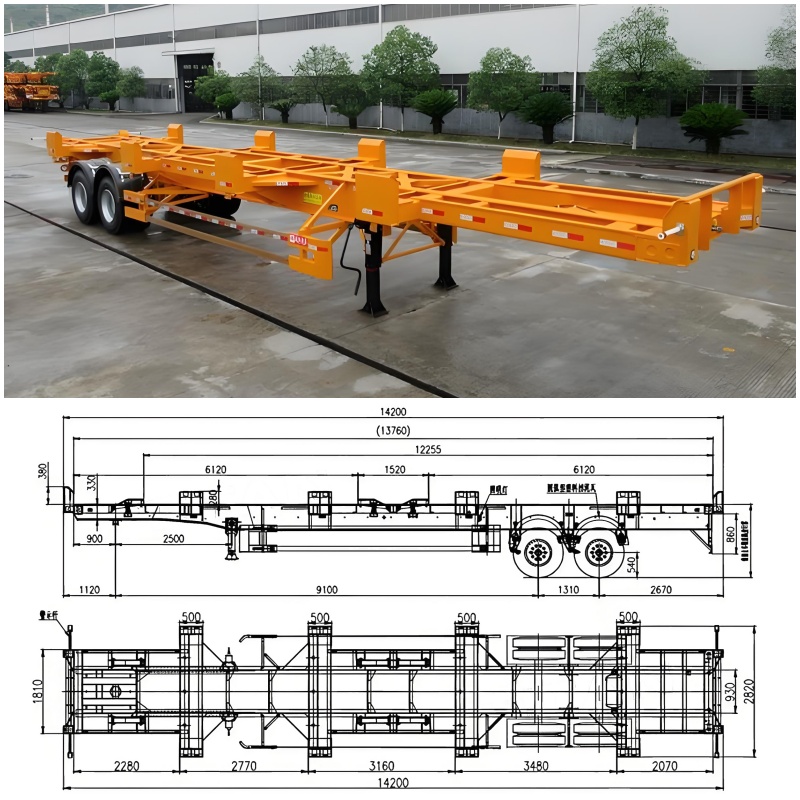
Unlike standard cargo trailers, a dedicated container trailer replaces heavy wooden or steel solid flooring with an optimized, high-strength structural skeletal steel frame. By eliminating unnecessary floor plates and side walls, these trailers significantly reduce tare vehicle weight (deadweight), allowing fleet operators to maximize cargo payload capacity while remaining strictly compliant with highway axle-load limits. Each unit is equipped with heavy-duty ISO corner-casting twist locks, enabling crane operators at ports and rail hubs to load and secure containers in seconds without needing manual chains, straps, or complex load-securing tie-downs.
Key Advantages of Modern Container Transport Semi Trailers
Rapid Load & Unloading Cycles: Standardized twist-lock mechanisms allow rapid container mounting and releasing, significantly shortening vessel and train turnaround times at busy port terminals and rail depots.
Optimized Tare Weight for Higher Payloads: Fabricated using high-tensile structural steel (such as Q345B, Q690D, and T700), the open skeletal design minimizes chassis mass without sacrificing frame rigidity or beam deflection strength under severe concentrated loads.
Lowered Center of Gravity: Purpose-built low-profile chassis drop the container lower to the road surface, dramatically improving vehicle rollover stability during high-speed highway cornering and reducing wind resistance for improved tractor fuel economy.
Multimodal System Integration: Designed in strict accordance with international ISO container standards, allowing seamless handling of dry van containers, high-cube units, refrigerated (reefer) containers, open-top units, and liquid ISO tank containers.
Container Chassis vs. Standard Flatbed Semi Trailer: A Comprehensive Comparison
When expanding an intermodal transport fleet, purchasing managers often weigh the trade-offs between dedicated container trailers and multipurpose transport platforms. While a versatile Flatbed Semi Trailer features a solid checkered steel or hardwood floor capable of transporting non-containerized breakbulk cargo, lumber, bagged cement, steel coils, and machinery, it incurs a higher tare weight penalty. For specialized shipping container logistics, a dedicated container chassis provides a far lighter, more fuel-efficient, and lower-maintenance solution.
| Operational Dimension | Dedicated Container Chassis / Skeletal Trailer | Multipurpose Flatbed Semi Trailer |
|---|---|---|
| Primary Target Cargo | ISO Containers (20ft, 40ft, 45ft, High Cube, ISO Tank) | Containers, breakbulk freight, steel coils, bagged cement, lumber |
| Tare Weight Range | Ultra-Lightweight: 3,500 kg – 5,500 kg | Standard Heavy-Duty: 6,800 kg – 8,500 kg |
| Deck Construction | Open Skeletal Main Beams with Crossmembers & Outriggers | Full Steel Checkered Plate or Hardwood Flooring over Crossbeams |
| Container Fixing Method | Integrated ISO Retractable Twist Locks (4 to 12 units) | Surface-mounted Twist Locks + Side Rope Hook Points |
| Aerodynamic Drag & Fuel Efficiency | Lower air resistance under chassis; maximum fuel savings | Higher tare mass and flatbed surface drag; higher fuel burn |
| Maintenance Overhead | Minimal: Simple steel frame with fewer wearable surface parts | Moderate: Floor plate maintenance, rust prevention, plank replacement |
2. Comprehensive Classification: Choosing the Right Chassis Type
International freight routes vary drastically. A vehicle operating on smooth highway corridors between European logistics hubs faces vastly different operational demands than a heavy-haul trailer navigating unpaved road conditions in African mining regions or high-density port terminals in Southeast Asia. To address these diverse operational requirements, our trailer configurations are categorized by container length compatibility, structural engineering, and axle payload capacity.
2.1 Classification by Container Size & Operational Flexibility
20ft Compact Container Chassis: Engineered specifically for single 20-foot standard international shipping containers or ISO liquid tank containers. Featuring a compact wheelbase (typically 7.2m to 8.2m overall length), this chassis excels in congested urban distribution yards, tight port ramps, and short-haul city intermodal routes. Despite its compact footprint, reinforced main beams allow it to handle heavy payloads up to 35–40 tons, making it a favorite for heavy liquid tank transport.
40ft Standard Container Chassis: The workhorse of global container haulage. Measuring 12.4m to 12.6m in length, this vehicle is configured to carry either one 40ft standard dry/reefer container or two 20ft containers loaded back-to-back. Equipped with 8 to 12 ISO twist locks (including middle retractable locks), it provides total flexibility for intermodal logistics operators handling mixed container sizes daily.
45ft+ Extended Chassis: Custom-built for high-volume, low-density cargo regional logistics. Widely used in North American and Australian freight corridors, these extended trailers feature reinforced rear overhangs and extended wheelbases to accommodate oversized high-cube containers and domestic intermodal boxes without exceeding rear swing-radius limits.
Telescopic / Extendable Container Chassis: Designed for fleet managers seeking maximum asset utilization. Featuring a heavy-duty pneumatic or manual sliding central frame mechanism with locking pins, a single extendable trailer can adjust its frame length dynamically from 20ft up to 40ft or 45ft. This eliminates empty return runs by enabling a single vehicle to transport a 20ft container to a destination and return with a 40ft container on the backhaul.
2.2 Classification by Structural Engineering & Application
Straight Frame Chassis: Features a continuous horizontal beam structure from the kingpin plate to the rear lights. This traditional design is rugged, cost-effective, and highly reliable for standard 8'6" height ISO containers and heavy freight applications.
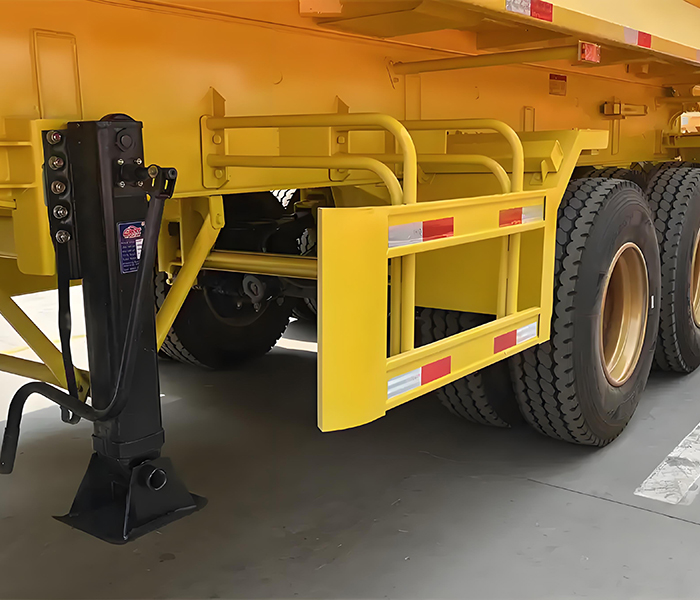
Gooseneck Drop Frame Chassis: Specifically engineered to solve height limit regulations when transporting 9'6" High Cube (HC) containers. The lowered gooseneck structure at the front embeds into the "gooseneck tunnel" found under High Cube containers. This drops the total overall vehicle height by several inches, allowing transit under low-clearance highway bridges, power lines, and tunnels while complying with strict 4.0m road height laws. Explore our range of optimized Container Chassis models to find the perfect drop-frame specification.
Terminal / Port Chassis (Bomb Cart Trailer): Purpose-built exclusively for enclosed port terminal yards, container depots, and railway transfer hubs. Unlike highway-legal trailers, a "Bomb Cart" features heavy-duty un-sprung suspension, extra-wide funnel-shaped side guide plates, and a reinforced steel structure. The funnel guides allow gantry crane operators to drop containers onto the chassis rapidly without needing precise manual alignment, significantly speeding up vessel loading and unloading cycles at speeds up to 40 km/h.
Hydraulic Tilting / Dump Chassis: Combines a container chassis frame with a heavy-duty front hydraulic tipping cylinder (such as HYVA systems). This allows the trailer frame to tilt at angles up to 45 degrees, making it the ideal solution for discharging bulk granular cargo, grain, plastic pellets, scrap metal, or mineral ores directly from 20ft or 40ft shipping containers without needing specialized container-tipping quay machinery.
2.3 Axle Layout & Payload Capacity Matrix
Selecting the correct axle count and spacing configuration is vital to balance legal gross vehicle weight (GVW) limits with structural durability under heavy concentrated loads. Below is an engineering overview of standard axle layouts:
| Axle Layout | Tare Weight Approx. | Rated Payload Capacity | Primary Application & Environment |
|---|---|---|---|
| 2-Axle Single Tire / Dual Tire | 3,500 – 4,200 kg | 25 – 35 Tons | Short-haul port shuttles, city distribution, light 20ft/40ft container transport under strict GVW road laws. |
| 3-Axle Standard Single / Dual Line | 5,000 – 6,200 kg | 40 – 55 Tons | The global industry standard for long-haul highway logistics, international cross-border freight, and heavy 40ft/45ft containers. |
| 4-Axle (Tri-Axle + Lift Axle / Rear Steering) | 6,800 – 8,000 kg | 60 – 75 Tons | Heavy-haul overload logistics, mining regions, and countries with severe axle load restrictions (e.g., East & West Africa). Allows lifting one axle when empty to reduce tire wear. |
3. Advanced Anti-Corrosion Engineering & Manufacturing Craftsmanship
Container shipping trailers operate under some of the most aggressive corrosive conditions in the transportation industry. Exposure to salty sea air at ocean container ports, de-icing chemical salts on winter highways, intense UV radiation, and continuous mechanical vibration can cause rapid rust, frame fatigue, and premature structural failure if manufacturing quality is compromised.
High-Strength Steel Selection & Submerged Arc Welding (SAW)
The structural integrity of a skeletal trailer depends entirely on its main longitudinal I-beams. We utilize high-yield structural steel grades—including Q345B, Q690D, and T700 (HG60)—which offer yield strengths up to 700 MPa. The main beams are fabricated using fully automated, double-sided continuous Submerged Arc Welding (SAW) technology. This process ensures deep, uniform weld penetration along the entire length of the top flange, web plate, and bottom flange, eliminating internal stress concentrations and preventing weld cracking under severe torsional twisting and heavy dynamic road impacts.
Industrial Surface Treatment & Multilayer Paint System
To ensure a service life exceeding 10–15 years in high-salinity coastal environments, every trailer frame undergoes a rigorous multi-stage surface preparation and painting process:
SA 2.5 Shot Blasting Pre-Treatment: Before priming, the entire welded steel frame enters a high-velocity automated shot blasting chamber. Steel shot abrasive blasts away all mill scale, welding slag, surface rust, and oil residues, achieving an SA 2.5 cleanliness profile with an ideal surface roughness anchor pattern for paint adhesion.
High-Build Epoxy Zinc-Rich Primer: Immediately following shot blasting, an industrial-grade zinc-rich epoxy primer is sprayed across all frame surfaces, crossmembers, outriggers, and undercarriage components. The zinc content acts as a sacrificial anode, actively preventing rust creeping even if the topcoat is scratched during container loading.
Polyurethane Topcoat Baking Finish: The final coat consists of a high-solids, heavy-duty polyurethane finish paint. Baked in a temperature-controlled booth, this coating provides high color retention, UV radiation resistance, and high chemical resistance against salt spray, diesel fuel, and highway road chemicals.
4. Global Regional Compliance & Road Regulations Guide
Navigating international transport laws is essential when purchasing semi trailers for global markets. Weight limits, axle spacing, overall vehicle dimensions, and safety equipment requirements vary significantly between regions. Our engineering team customizes every Skeleton Semi Trailer to ensure 100% road compliance in your destination country:
North American Market (US DOT / Canada MOT Standards): Trailer designs must strictly adhere to Federal Bridge Gross Weight Formulas, specifying precise kingpin-to-rear-axle center distances. Requirements include DOT-certified LED lighting, sealed wiring harnesses, mandatory ABS braking systems, heavy-duty rear underrun protection guards, and specific side marker reflectors.
African & Middle Eastern Markets: Logistics operators in these regions often face severe road conditions, unpaved gravel tracks, high ambient temperatures, and extreme payload demands. Trailers built for these markets prioritize heavy-duty mechanical leaf spring suspensions with reinforced multi-layer spring leaves, 13-ton to 16-ton heavy-duty axles (e.g., FUWA or BPW style), reinforced double-web main beams, and high ground clearance.
European & Australian Markets: Requires compliance with strict overall length limits, precise turning radius regulations, mandatory electronic braking systems (EBS) with roll stability control (RSC), side protective guards to protect cyclists and light vehicles, and air bag suspension systems to minimize road pavement damage.
5. How to Save Ocean Freight: Smart Packing & Shipping Solutions
For international buyers, ocean freight charges can account for a substantial percentage of the total landed cost of a semi trailer. Standard fully assembled chassis trailers occupy immense volumetric space aboard ocean vessels. To help our global clients minimize logistics expenses, we offer two highly optimized export packaging and shipping methods:
1. 3-in-1 Stacked Transport Solution (RORO / Bulk Carrier)
When shipping via Roll-on/Roll-off (RORO) or Breakbulk vessels, we utilize a specialized stacking design. Three individual container chassis trailers are stacked vertically into a single tightly secured transport bundle. The top chassis units are inverted or mounted onto engineered steel shipping brackets welded to the bottom trailer. This reduces the total freight measurement volume (CBM) by over 60%, allowing buyers to pay sea freight for essentially one vehicle slot while transporting three complete trailers.
2. Modular Knock-Down (SKD) Containerized Packing
To eliminate expensive RORO shipping altogether, we offer modular chassis designs featuring bolted or pin-connected rear axle frames, removable goosenecks, and detachable side outriggers and landing legs. Through this Semi-Knock-Down (SKD) engineering, up to 2 or 3 complete 40ft container chassis can be disassembled and packed securely inside a single standard 40ft High Cube (40HQ) maritime container. This protects the trailers entirely from ocean salt air corrosion during transit while cutting sea freight costs by up to 40–50% compared to conventional shipping methods.
6. 5-Step Buying Decision Tree for Fleet Owners
To assist fleet managers, procurement officers, and logistics contractors in selecting the exact vehicle specification for their operational requirements, follow this step-by-step decision matrix:
Step 1: Define Cargo & Container Specifications: Identify the exact container types handled in your daily operations (20ft dry van, 40ft standard, 45ft high cube, 20ft heavy liquid tank container, or port terminal containers). If carrying tall 9'6" High Cube boxes, select a Gooseneck drop-frame chassis.
Step 2: Calculate Required Gross Payload: Evaluate maximum cargo weight plus container tare weight. Choose a 2-axle configuration for light-to-medium city haulage (under 35 tons payload), a 3-axle layout for global standard heavy logistics (40–55 tons), or a 4-axle heavy-haul chassis for severe overload conditions.
Step 3: Match Operating Environment to Structural Type: Select a standard skeleton trailer for highway intermodal runs, an extendable chassis for mixed 20ft/40ft fleet versatility, a hydraulic dump chassis for bulk discharging, or an un-sprung Bomb Cart Trailer for enclosed port terminal shuttle operations.
Step 4: Select Suspension & Braking Configurations: Choose heavy-duty mechanical leaf spring suspension for rugged, unpaved off-road conditions and easy local repair. Select air suspension for smooth long-haul highway logistics, tire protection, and automated height adjustment. Ensure the braking system (Dual air line, ABS, or EBS) matches local highway regulations.
Step 5: Determine Shipping & Delivery Method: Decide between fully assembled 3-in-1 stacked bundle transport or modular SKD containerized packing based on destination port handling facilities and ocean freight budget constraints.


7. Preventative Maintenance & Inspection Checklist
Implementing a structured preventive maintenance schedule is critical to ensure fleet safety, prevent costly roadside breakdowns, maintain highway safety compliance, and maximize the operational lifespan of your container transport trailers:
| Maintenance Interval | Target Assembly | Detailed Inspection & Service Tasks |
|---|---|---|
| Pre-Trip / Daily Inspection | ISO Corner Twist Locks | Inspect all twist-lock handles, locking pins, and safety latch pins. Ensure smooth 90-degree rotation and verify middle retractable locks drop completely flush when carrying long containers. |
| Pre-Trip / Daily Inspection | Pneumatic Brake System | Check glad hand seals and air hoses for leaks. Drain accumulated moisture condensation from air reservoirs. Test emergency and service brake response times. |
| Weekly / 1,000 km | Tires & Wheel End Assembly | Inspect cold tire inflation pressure across all dual tires. Check tread wear patterns for alignment issues. Torque wheel lug nuts to manufacturer specifications. |
| Monthly / 5,000 km | Suspension & Axles | Inspect suspension leaf springs for broken leaves or shifting. Check U-bolt torque. Inspect torque arms, rubber bushings, and air bag suspension bellows for inflation leaks. |
| Quarterly / 15,000 km | Kingpin & Landing Gear | Inspect the 2" or 3.5" kingpin plate for wear or cracking. Clean and apply fresh heavy grease to the kingpin surface and landing gear internal two-speed gears. |
| Bi-Annually / 30,000 km | Structural Frame & Electrical | Perform a full visual inspection of main I-beam welds, crossmembers, and twist-lock housing brackets for fatigue cracks. Inspect sealed wiring harnesses and junction boxes for insulation wear or corrosion. |

