Views: 0 Author: Site Editor Publish Time: 2026-08-04 Origin: Site
A trailer can fit your container yet still fail your route. Poor matching raises axle loads, delays terminals, and increases repair costs. The right Container Semi Trailer starts from your cargo, roads, and local rules—not the lowest quotation. This guide explains trailer types, container compatibility, axle selection, safety components, supplier checks, and lifetime cost. You will leave ready to compare offers using one practical specification.
Start with twelve months of shipment records, not a supplier catalog. List each container length, cargo type, loaded mass, and monthly frequency. Include 20-foot, 40-foot, 40-foot high-cube, 45-foot, reefer, and ISO tank units where relevant. Record both average and heaviest verified loads because peak cargo determines the required structure.
A short 20-foot container may create a concentrated load near the trailer center. A longer box spreads weight differently across the kingpin and axle group. Therefore, container length alone never determines a safe chassis. Ask your operations team for actual weighbridge tickets whenever they exist.
Next, trace every movement from port pickup to final return. Note highway distance, yard speed, road quality, gradients, turning space, salt exposure, and daily trips. Port-only work rewards fast locks and simple maintenance. Long-haul work places more value on braking, ride quality, tires, alignment, and corrosion protection.
Operating question | Why it changes the specification |
Which container sizes dominate? | It determines frame length and twist-lock positions. |
What is the maximum loaded mass? | It influences frame, axles, tires, brakes, and legal payload. |
Are roads paved or rough? | It affects suspension choice, clearance, and reinforcement. |
Is lifting equipment always available? | It decides whether a standard chassis is practical. |
How many trips run daily? | It changes durability, service access, and spare-parts needs. |
Measure the tractor fifth-wheel height and check the kingpin standard. Confirm air couplings, electrical voltage, connector type, turning clearance, and permitted overall height. High-cube containers can create clearance problems when deck height is overlooked. Terminal cranes and reach stackers also need clear access to corner fittings.
Send this operating profile to every bidder in the same format. You will receive comparable proposals and expose missing assumptions early. A serious quotation should state the trailer tare, rated capacity, axle loads, lock layout, dimensions, and intended operating conditions.
A skeletal container trailer uses a light steel frame and dedicated twist locks. It usually suits repeated port-to-warehouse movements because it carries little unused deck material. Lower tare may improve legal payload and fuel use. However, it cannot efficiently carry ordinary loose cargo after the container is removed.
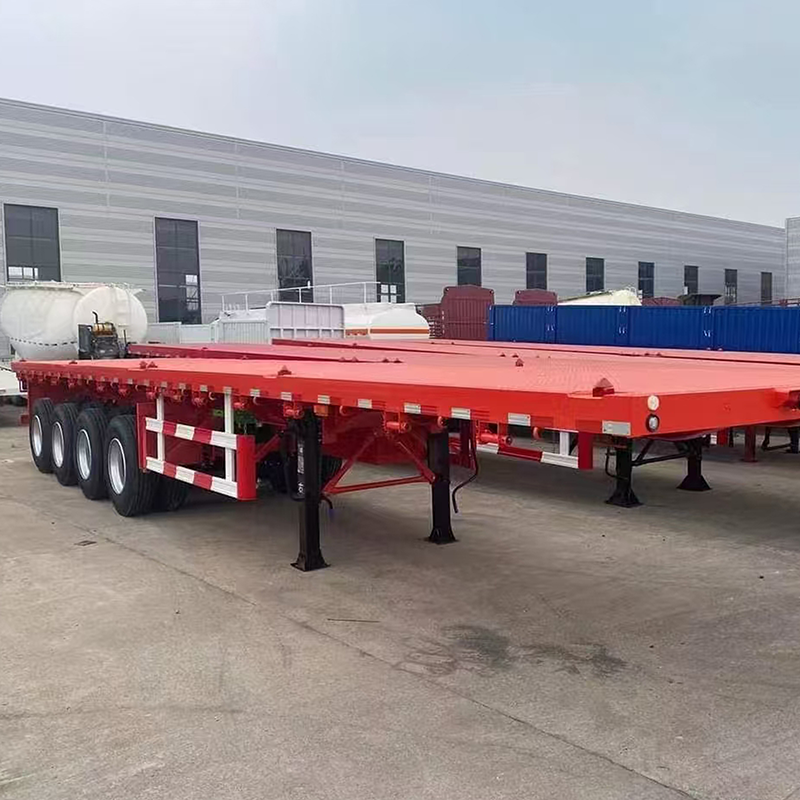
A flatbed container semi trailer adds a full deck plus container locks. It can move containers, steel, machinery, pallets, or construction materials when correctly secured. That flexibility helps fleets facing uneven container demand. The tradeoff is higher tare, more deck maintenance, and possibly less legal cargo capacity.
Trailer design | Best operating fit | Main purchasing caution |
Fixed skeletal chassis | Repeated transport of one standard container length | Limited flexibility when the container mix changes |
Flatbed container trailer | Containers plus general or project cargo | Higher tare and added deck upkeep |
Extendable or combo chassis | Mixed 20-foot and 40-foot operations | More pins, joints, and inspection points |
Gooseneck chassis | Long-haul 40-foot or high-cube work | Confirm container tunnel and tractor compatibility |
Terminal or bomb cart | Short, controlled movements inside ports | It may not meet public-road requirements |
An extendable container chassis trailer can improve fleet utilization across mixed container lengths. Yet adjustable structures add weight, moving parts, and maintenance tasks. Estimate how often a fixed trailer would remain idle. Buy flexibility when extra utilization exceeds its higher purchase and service costs.
The Container Semi Trailer range from Boca Auto shows skeletal, flatbed, chassis, and terminal configurations. Use such a range to identify possibilities, then specify one duty cycle. Avoid ordering a versatile design merely because it lists more container sizes.
Standard chassis depend on cranes, gantries, or reach stackers for container transfer. Remote destinations may require a side loader or tilting solution instead. Those systems add hydraulics, tare, training, and maintenance. Check ground strength, overhead clearance, stabilizer space, and unloading time before choosing self-loading equipment.
International containers use standardized dimensions, but buyers must confirm the exact series and type. ISO 668:2020 covers classification, dimensions, and ratings for Series 1 freight containers. Your drawing should identify supported lengths, tunnel details, lock centers, and permitted loading positions. Never accept “20/40 compatible” without a clear lock-layout drawing.
High-cube containers share common plan dimensions yet add height. Reefers also need clearance around machinery, plus a suitable power plan during land transport. ISO tanks often carry dense liquid loads.
Start from the lowest applicable limit in the entire vehicle combination. Consider trailer rating, axle capacities, tire ratings, kingpin load, tractor limits, and road law. Subtract tractor, trailer, container, fuel, driver, tools, and accessories from the permitted gross combination mass. The remainder is the legal cargo allowance for that route.
Weight term | Meaning for the buyer |
Trailer tare | Empty trailer mass, including installed options |
Container tare | Empty container mass shown on its safety plate |
Payload | Cargo mass carried inside the container |
Gross trailer mass | Trailer, container, cargo, and fitted equipment |
Axle load | Mass transferred through one axle or axle group |
Do not treat a 60-ton structural claim as permission to haul 60 tons. National rules may allow far less on public roads. Bridge formulas, axle spacing, tire width, and permits can change the result. Ask a qualified local transport engineer to approve the final configuration.
Two axles may suit lighter loads and favorable regulations. Three axles can distribute heavier loads, support rougher duty, or meet specific axle limits. Four axles serve specialized heavy transport in certain markets. Extra axles also add tires, brakes, rolling resistance, turning scrub, and maintenance.
Request a load-distribution calculation for every approved container position. It should show kingpin load and individual axle-group loads at maximum cargo mass. Include a centered 20-foot box on a 40-foot chassis if you plan that operation. Verify the tractor can accept the resulting fifth-wheel load without exceeding its front or rear limits.
The main beams must handle bending, twisting, repeated loading, and road shock. Ask for steel grade, plate thicknesses, material certificates, welding procedures, and critical-weld inspection records. Crossmembers should transfer concentrated loads without creating weak stress points. Drainage and coating access matter because trapped saltwater accelerates corrosion.
Container locks must match the corner-fitting geometry defined for the intended boxes. ISO 1161:2016 addresses dimensions plus functional and strength requirements for Series 1 corner fittings. Inspect every lock for correct position, smooth rotation, positive engagement, and visible lock status. Replace bent handles, worn pins, or cracked mounting plates before operation.
Braking rules differ between countries, so name the required system in the purchase contract. Confirm service brakes, parking brakes, emergency function, chambers, valves, air tanks, hoses, and anti-lock features. The tractor and trailer systems must communicate correctly. Ask for test results matching the delivered axle, tire, and brake configuration.
Choose suspension for the route rather than habit. Mechanical suspension is simple, durable, and widely repairable. Air suspension can improve ride quality, height control, and load sharing. It adds bellows, valves, and air-line service needs. Rough roads may justify reinforcement, although unnecessary steel raises tare and fuel use.
Axles, wheels, and tires: Check ratings, track width, bearing service, tire size, speed index, and local availability. Every tire must carry its share of the maximum calculated load. A rare size can create long downtime far from the supplier.
Landing gear and kingpin: Confirm static capacity, mounting reinforcement, operating clearance, and coupling standard. Loaded uncoupling requires firm ground and correct support procedures. Inspect welds and fasteners around these high-stress interfaces.
Lighting and protection: Specify compliant lamps, reflectors, wiring connectors, side guards, underrun protection, mudguards, and markings. Salt-resistant electrical connectors reduce common field faults. Arrange access so technicians can repair wiring without cutting sealed frame sections.
Boca Auto states it uses high-strength Baosteel, automated welding equipment, staged inspections, and powder-coating facilities. Treat these as supplier claims requiring model-specific evidence. Confirm material certificates, production photos, coating preparation, dimensions, and inspection results for the actual units ordered.
A trailer crossing an ocean must still become legal road equipment after arrival. Check national rules for dimensions, axle weights, brakes, lighting, underrun guards, tires, registration, and identification. Some markets require type approval or approved components. Others demand official inspections before local registration. Verify the rules before freezing drawings or paying a deposit.
Create a document list inside the purchase contract. It may include signed drawings, component schedules, serial numbers, material records, and brake data. Add weld reports, certificates, manuals, parts books, and packing details. State which party handles approval, customs documents, and registration. A vague “international standard” promise offers little protection.
Review factory capability, quality controls, traceability, engineering response, and export packaging. Ask how design changes receive approval. Confirm axle, brake, suspension, tire, landing-gear, and lock brands before production. Substitutions should require written consent because one cheaper component can disrupt local parts support.
Boca Auto presents pre-production drawings, production videos, remote inspection, technical support, and warranty coverage for its trailers. Its 20-foot/40-foot skeletal model lists configurable axles, load ranges, brakes, suspension, landing gear, and locks. Buyers should place the agreed values and exact warranty period in the final contract.
Arrange an independent pre-shipment inspection for significant orders. Inspect dimensions, tare, welds, coating, locks, air leaks, brakes, lights, wheel torque, and markings. Photograph serial numbers and component labels. Record every defect plus the accepted correction before loading the trailers for export.
Purchase price represents only one line. Estimate financing, ocean freight, import charges, registration, fuel, tires, scheduled service, repairs, downtime, parts inventory, and resale value. A lighter fixed chassis may win on repeated container lanes. A costlier combo design may win when it prevents idle equipment.
Score each quotation using the same weighted matrix. Give safety and compliance pass-or-fail status. Then rate payload, utilization, service access, parts availability, warranty, delivery, and lifetime cost. This approach prevents an attractive price from hiding an unusable or expensive specification.
The right Container Semi Trailer fits more than a container. It matches cargo weight, axle laws, tractors, terminals, roads, and maintenance resources. Define the duty cycle first, compare suitable designs, then verify every load calculation and component. A clear contract plus pre-shipment inspection protects safety, uptime, and long-term value across international routes.
A: Common models carry 20-foot, 40-foot, or 45-foot ISO containers. Fixed chassis support specific lengths, while combo or extendable designs support several positions. Confirm lock centers, container tunnel details, gross mass, and legal axle loads on the signed drawing.
A: A skeletal trailer usually has lower tare and suits dedicated container transport. A flatbed carries containers plus other secured cargo, improving flexibility. Choose using shipment frequency, legal payload, empty mileage, deck maintenance, and alternative cargo demand.
A: The answer depends on loaded mass, axle spacing, route rules, tires, and tractor limits. Two axles may handle lighter work. Three or four axles can distribute heavier loads. Require a route-specific load calculation before ordering.
A: Check correct lock position, smooth operation, full engagement, handle security, cracks, wear, and mounting damage. Inspect all locks before departure and after container transfer. Never move a container using a damaged or partly engaged lock.
A: Request signed drawings, specifications, component lists, material records, and inspection reports. Also collect manuals, parts books, warranty terms, serial numbers, and required approval documents. The exact package depends on the destination market and registration process.