Views: 0 Author: Site Editor Publish Time: 2026-08-04 Origin: Site
A trailer can carry your machine yet still fail at the first bridge. Payload alone does not make a transport plan safe or legal.
Selecting a Heavy Haul Semi Trailer requires matching equipment weight, dimensions, center of gravity, loading method, tractor, and route. One missed detail can create permit delays, axle overloads, or dangerous unloading.
This guide explains trailer types, deck geometry, axle layouts, securement, supplier evidence, and lifetime cost. You will finish with a practical specification for oversized equipment transport.
Begin with the machine, not a trailer catalog. Record its transport weight from a plate, manual, or recent scale ticket. Include attachments, counterweights, fuel, fluids, tools, and removable parts. Then measure length, width, and height in the exact transport position.
Photograph the machine from every side. Mark its center of gravity, lifting points, approved tie-down points, tire or track contact areas, and lowest ground clearance. These details determine safe placement before loading begins. For articulated equipment, record how the boom, blade, bucket, or steering joint locks during travel.
Equipment data | Why the trailer designer needs it |
Verified transport mass | Establishes structural demand and possible legal weight |
Overall transport dimensions | Sets deck length, width, height, and extension needs |
Track or tire footprint | Reveals concentrated loads across beams and deck plates |
Center of gravity | Guides placement, axle reactions, and stability checks |
Ground clearance | Determines ramp angle and possible grounding points |
A heavy haul trailer load capacity is only a starting point. Total payload does not show how a crawler distributes weight across two narrow tracks. A transformer may place greater force through four small supports. Ask for allowable concentrated loads, deck deflection, and placement limits.
Also separate payload from gross vehicle weight. Trailer tare, ramps, outriggers, toolboxes, spare wheels, and hydraulic equipment consume carrying capacity. The remaining structural payload may still exceed legal axle, tire, suspension, brake, or bridge limits.
List your frequent loads and the rare maximum load separately. Record annual trips, road distance, travel speed, terrain, climate, and loading surface. A lowboy trailer for excavator transport faces different demands on mining roads than on paved highways.
Check site access before choosing extra deck length or axles. Tight gates, soft yards, steep transitions, and short turning areas can defeat a capable trailer. Include likely future machines, but avoid paying for capacity your routes cannot use.
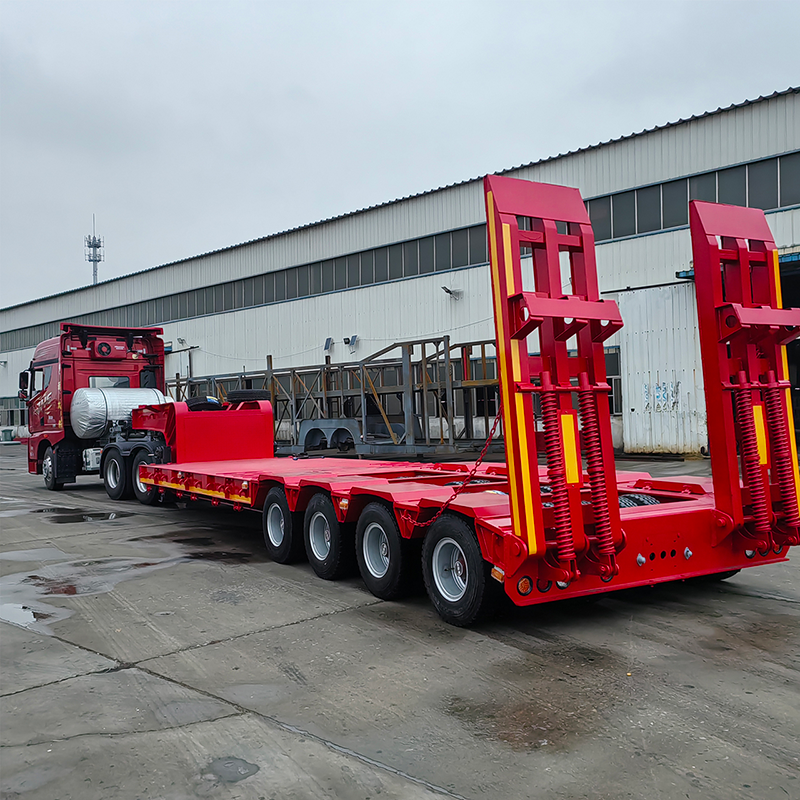
Choose the layout from the cargo profile and loading process. Start with the load you move most often. BOCA’s Heavy Haul Semi Trailer range includes lowbed, removable gooseneck, extendable, and multi-axle options. Each solves a different clearance, length, or loading problem.
Trailer configuration | Best fit | Main trade-off |
Fixed-neck lowbed | Regular machines loaded by ramp or crane | Simple design, but rear ramp angles may be steep |
RGN lowboy trailer | Self-propelled excavators, dozers, and loaders | Easy front loading, but greater cost and tare |
Hydraulic gooseneck | Low-clearance tracked equipment | Gentle approach, but hydraulics add maintenance |
Double-drop trailer | Tall machinery needing maximum vertical clearance | Low center deck limits usable well length |
Extendable lowboy | Long tanks, beams, modules, or machinery | Added length affects turning and structural weight |
Multi-axle trailer | Very heavy, concentrated, or route-limited loads | Better distribution, but more tires and route complexity |
An RGN, or removable gooseneck trailer, lets the front deck become a loading ramp. It suits equipment that can drive under its own power. A hydraulic gooseneck can reduce the approach angle further, protecting low undercarriages and improving crew control.
Decide whether crews will drive, winch, tow, or crane the cargo aboard. Confirm ramp capacity, width, traction surface, transition angle, and safe working space. Wet tracks and dusty steel can become slippery, even when the angle appears acceptable.
Rear-loading ramps need enough ground behind the trailer. Front-loading RGN designs need room around the tractor and neck. Crane loading requires verified lifting points and a deck structure designed for landing impacts.
A custom heavy haul trailer should cover the loads earning most revenue. An oversized configuration can increase tare, tire drag, turning radius, and permit costs on every ordinary trip. Rare extreme moves may be better handled through rental or a specialist carrier.
Compare loading minutes, crew size, site setup, and missed-job risk. A more complex trailer earns its cost only when the added function improves regular operations. Measure that gain against annual usage.
Start with the lower of the manufacturer’s structural rating and the permitted operating limit. Subtract the complete trailer tare, including ramps, widening devices, hydraulics, spare parts, and accessories. Never label the remainder as legal payload before checking axle and route rules.
Request a load-distribution drawing for your heaviest machine. It should show kingpin reaction, every axle-group reaction, tire loading, and deck contact pressures. Ask the engineer to model both the normal position and any practical loading error.
Component ratings must support the same case. Review tires, rims, axles, suspension, brakes, kingpin, fifth wheel, landing gear, and hydraulic systems. One weaker component can reduce the usable heavy haul trailer load capacity.
More axles do not automatically make an overweight move legal. Axle spacing affects bridge loading, turning scrub, and allowable route weight. Steerable or liftable axles may help certain operations, but they add controls, maintenance, and operator training.
Ask how the suspension equalizes load across uneven pavement. Review tire capacity at the required speed and pressure. If axles steer or lift, confirm their control logic, fail-safe behavior, and permitted use under load.
Specify usable deck length rather than overall length. Confirm the low well, front and rear transitions, wheel pockets, beam clearance, side extensions, and outrigger positions. The machine must sit where axle reactions remain acceptable.
Lowboy trailer deck height controls total loaded height and center of gravity. However, an extremely low deck may scrape on crowns, ramps, rail crossings, or rough sites. Check loaded ground clearance, suspension travel, and departure angles.
Treat tractor and trailer as one vehicle. Verify fifth-wheel height and capacity, kingpin size, coupling clearance, air volume, electrical connectors, and hydraulic power needs. Confirm the tractor’s gross combination rating and permitted fifth-wheel load.
The tractor also needs enough traction, cooling, steering authority, and braking support for the route. A powerful engine cannot correct poor axle balance. Share the intended tractor specification before the trailer design receives final approval.
Measure loaded height, width, length, gross weight, axle spacing, and turning envelope. Then survey bridges, tunnels, overhead wires, roadworks, grades, sharp curves, rail crossings, and weak pavements. Include the origin yard and delivery site, where many moves encounter their tightest turns.
Test the approach to ramps and gates at loaded ground clearance. Long lowbeds can high-center on crests or strike their tails during transitions. A route drawing or swept-path study can expose these conflicts before fabrication.
Run the survey in both travel directions when the return path differs. Confirm fuel stops, rest areas, emergency pull-offs, and safe parking. Temporary construction or weather restrictions can invalidate a route that worked last month.
Oversize and overweight thresholds vary by country, state, province, and road. The Oversize/Overweight Load Permits provides a useful United States example. It shows how gross weight, axle weight, axle spacing, and state permits interact.
Ask the permit authority or experienced planner about escorts, travel windows, seasonal restrictions, signs, and lighting. Confirm bridge reviews and utility support. Do this before locking the axle layout. A small spacing change can affect route availability or permit cost.
Show every anchor point on the engineering drawing. Specify its capacity, pull direction, and access after the machine is loaded. Chain angles, deck edges, tracks, tires, and attachments can make a well-positioned anchor unusable.
Plan blocking, chocks, chain protectors, boom supports, and articulation locks for each machine. The cargo securement rules explain working-load limits and heavy-equipment requirements in the United States. Other markets have their own standards.
Provide safe inspection access around the loaded machine. Drivers must examine chains, binders, tires, hydraulics, lights, and heat without climbing into traffic. The final securement plan should follow local law, equipment instructions, and qualified engineering advice.
Perform a low-speed loading trial before the first commercial move. Record the machine position, chain arrangement, tire pressures, hydraulic settings, and inspection points. This creates a repeatable procedure for drivers and ground crews.
Ask for a dimensioned general arrangement, material grades, weld procedures, component data, and load calculations. BOCA’s hydraulic gooseneck lowbed model publishes configurable axles, suspension, brakes, loading capacity, and deck extension. These details still need confirmation against your machine and local rules.
Review main-beam depth, flange and web thickness, cross-member spacing, deck reinforcement, and tie-down integration. Request evidence for critical weld inspection and alignment. Check paint preparation, drainage, wiring protection, hydraulic hose routing, and corrosion control.
Arrange a factory acceptance inspection before shipment. Measure the finished trailer, verify tare on calibrated scales, operate hydraulics, test brakes and lights, and compare serial numbers. Record nonconformities and close them before final payment.
Send every supplier the same load sheet and duty cycle. Require written values for tare, structural capacity, axle reactions, deck height, ground clearance, and ramp angle. Also confirm turning needs and approved component brands. List exclusions clearly, including tools, spare parts, commissioning, and transport.
BOCA states it uses automatic laser cutting, locating systems, welding equipment, and high-strength steel in trailer production. Buyers should verify how those processes apply to the offered model. Inspection records and final drawings provide stronger evidence than general factory claims.
Confirm manuals, parts lists, warranty scope, response times, and regional component availability. Ask who supports hydraulic controls, brakes, suspension, and axles. A custom trailer loses value quickly when one unique part causes weeks of downtime.
Compare purchase price beside permits, fuel, tires, maintenance, inspection, loading labor, and downtime. Extra axles distribute weight but add tires, brakes, bearings, and scrub. Hydraulic systems shorten loading yet require seals, hoses, filtration, and trained operators.
Estimate cost per productive trip across several years. Include utilization, empty weight, route flexibility, resale demand, and the revenue from jobs the trailer enables. This view often favors a well-matched design over the cheapest quotation.
Model three usage cases: ordinary work, frequent heavy work, and the rare maximum move. Sensitivity checks reveal whether added capacity lowers cost or only raises tare. Use the same assumptions for every supplier.
The right Heavy Haul Semi Trailer is a complete transport system, not a payload number. Match verified equipment data to loading geometry, axle reactions, tractor capability, routes, permits, and securement.
Give each supplier one written specification. Then compare engineering evidence, support, and cost per productive trip. That process protects your equipment, schedule, and long-term hauling margin.
A: A lowbed describes the low deck. An RGN adds a removable neck for front loading.
A: Use verified cargo weight, trailer tare, component ratings, axle reactions, and local legal limits.
A: Choose one when cargo length exceeds the usable deck and the surveyed route permits extension.
A: Requirements depend on loaded dimensions, weight, axle spacing, route, and every governing jurisdiction.
A: Send weights, dimensions, center of gravity, contact points, loading method, tractor, route, and duty cycle.