Views: 0 Author: Site Editor Publish Time: 2026-06-01 Origin: Site
Fleet managers and logistics operators frequently face a difficult tradeoff. You must balance equipment versatility against specialized efficiency when handling shipping containers. A standard flatbed offers undeniable flexibility for varied cargo. However, it often sacrifices operational speed. Handling standardized shipping containers demands precise, purpose-built equipment to maximize route profitability.
This article objectively compares the structural, operational, and financial differences between these two trailer types. We want to help buyers align their fleet procurement with actual route demands and payload compliance. You will learn how structural layouts directly impact your load times, regulatory compliance, and daily operating expenses. We also explore specialized intermodal variations built for unique logistical challenges.
While traditional trailers offer excellent mixed-freight flexibility, a skeleton trailer strips away unnecessary mass. It maximizes your legal payload capacity. It significantly accelerates intermodal turnaround times. Choosing the right asset fundamentally transforms your daily fleet economics.
The foundation of any semi-trailer defines its operational capabilities. The core distinction between flatbeds and skeletal designs lies in how they manage load-bearing stresses.
A traditional flatbed relies on a continuous load-bearing deck. Manufacturers design this deck to support varied and highly irregular freight profiles. The floor usually consists of heavy-duty Apitong wood, aluminum, or reinforced steel. This continuous surface allows operators to load everything from palletized bricks to industrial machinery.
However, this versatility requires extensive hardware. Flatbeds need continuous rub rails, heavy stake pockets, and winch tracks along the perimeter. Drivers must carry heavy dunnage (wood blocking) to level cargo. These components add immense weight. They also complicate the baseline architecture of the trailer.
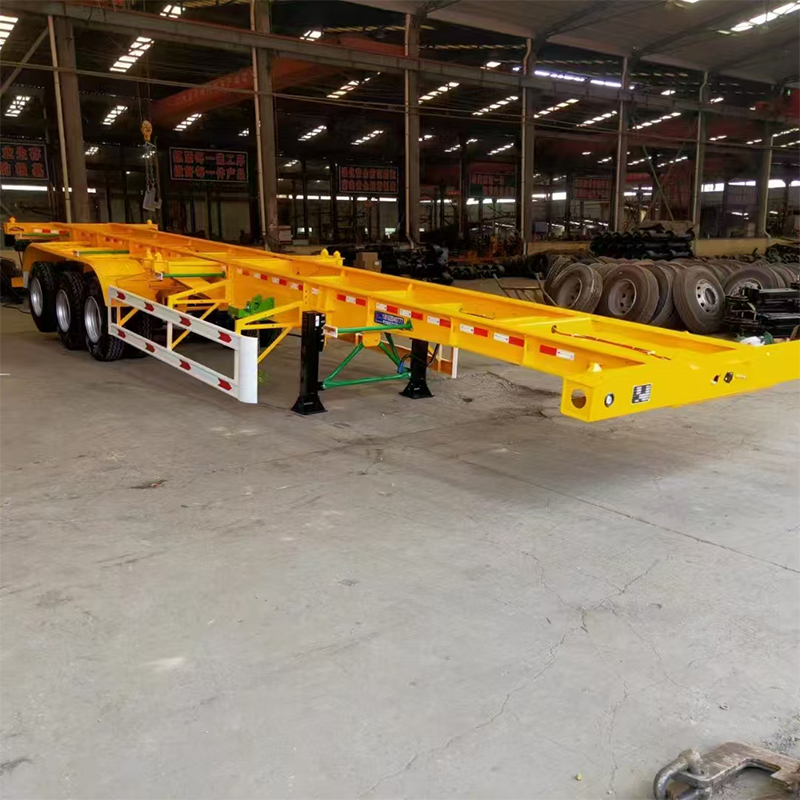
Engineers build skeletal chassis specifically for standardized ISO containers. They strip away the continuous deck completely. Instead, they utilize a minimalist, high-strength steel frame. Most manufacturers use Q345B or ASTM A572 steel. This material provides exceptional yield strength while maintaining flexibility.
The open frame supports the container at its strongest points: the four corner castings. It replaces a heavy, continuous floor with 4 to 12 strategically placed twist locks. These outriggers extend from the main I-beams. They align perfectly with standard 20-foot, 40-foot, or 45-foot container dimensions.
Trailer maintenance directly impacts fleet uptime. Flatbed decking deteriorates over time. Forklifts splinter wood floors. Heavy machinery warps steel plates. Repairing a damaged flatbed deck requires significant labor and downtime.
Conversely, a skeleton trailer features far fewer exposed components. The absence of a solid deck eliminates floor rot. It reduces the mechanical failure rate dramatically. You simply grease the twist locks and inspect the structural welds. This streamlined maintenance keeps the asset on the road earning revenue.
Every kilogram your trailer weighs is a kilogram you cannot bill to a customer. Weight optimization remains the most critical metric in intermodal logistics.
Heavy decking increases the unladen (tare) weight of a traditional flatbed. A standard 40-foot flatbed often weighs between 6,500 and 7,500 kg. This dead weight directly reduces your maximum legal payload before you hit Gross Vehicle Mass (GVM) limits. If your local regulations cap total vehicle weight at 80,000 lbs, a heavy trailer forces you to turn away heavier, more lucrative containers.
By removing the floorboards and side rails, skeletal trailers drop unnecessary mass. A standard container chassis often weighs under 4,000 kg. This massive weight saving unlocks higher legal cargo capacities. You can legally haul heavily loaded export containers safely.
A lighter chassis translates directly to reduced rolling resistance. Trucks experience less engine strain when pulling a stripped-down frame. You will notice demonstrably lower fuel consumption, especially on empty return legs (deadheading). Over thousands of miles, these fuel savings compound. They drastically improve your overall operating economics without requiring engine modifications.
Dragging a fully decked, heavy flatbed accelerates tire degradation. Multi-axle skeleton setups distribute weight more effectively. Many operators utilize tri-axle or quad-axle configurations for heavy loads. Advanced units include self-tracking rear axles. These steerable features prevent tire scrubbing during tight turns. Better weight distribution and reduced scrubbing extend tire life significantly compared to dragging un-optimized flatbeds.
| Specification Feature | Traditional Flatbed | Skeleton Chassis |
|---|---|---|
| Average Tare Weight | 6,500 kg - 7,500 kg | 3,500 kg - 4,500 kg |
| Payload Efficiency | Moderate (Deck mass reduces capacity) | High (Optimized for heavy containers) |
| Deadhead Fuel Burn | Higher (Heavier drag) | Lower (Minimal rolling resistance) |
Speed and safety dictate success in busy intermodal ports. The way a trailer secures cargo changes the entire dispatch timeline.
Traditional trailers force drivers into labor-intensive routines. Drivers must manually calculate tie-down working load limits. They must throw heavy chains or nylon straps over standard containers. This process is slow. It exposes operators to harsh weather. Furthermore, strapping a steel box is highly susceptible to human error. Loose straps lead to disastrous load shifts.
A skeletal design eliminates strapping completely. Drivers utilize standardized twist locks. These mechanical devices insert seamlessly into container corner castings. The driver simply rotates a lever to secure the box. It provides a rigid, fail-safe connection. This cuts securing times from thirty minutes down to three minutes.
Physics favor the skeletal approach. A standard flatbed carries a container on top of its thick deck. This elevates the cargo high above the axles. A skeletal design features cut-outs and a recessed frame. It inherently seats the container much lower to the axles. This lower center of gravity reduces sway risks during high-speed transit. It massively improves the static rollover threshold during tight highway cornering.
Drivers rarely see the inside of a sealed intermodal container. They cannot verify the internal load distribution. The cargo might be nose-heavy or tail-heavy. Utilizing a dedicated skeleton chassis with proper axle spacing ensures predictable compliance. Modern skeletal trailers position axles to distribute standardized container weights perfectly. This helps fleets pass strict DOT and AAR enforcement checks at weigh stations.
Traditional flatbeds have variations like drop-decks or lowboys. However, skeletal designs have evolved into highly specific sub-categories. Engineers created these variants to solve niche intermodal problems.
This variant features a stepped-down front section. The frame drops slightly behind the tractor's fifth wheel. This design is crucial for hauling refrigerated (reefer) containers. Reefer units have bulky generator sets attached to the front. The gooseneck clears these generators, preventing interference with the truck cabin. More importantly, it lowers the overall height of high-cube containers. This keeps the truck legally compliant under federal bridge clearance laws.
Container volumes change constantly. Buying separate trailers for every container length wastes capital. Telescopic frames solve this issue. They use modular sliding chassis beams locking via pneumatic pins. A single extendable trailer adjusts to fit 20ft, 40ft, 45ft, or 53ft containers. This mitigates the need for a fleet to maintain a massive, varied equipment pool.
Ports require specialized handling. Terminal trailers represent stripped-down, heavy-duty variants. Manufacturers design them strictly for closed-loop, high-frequency port operations. They lack highway lighting, ABS brakes, and highway suspensions. They are not street legal. Instead, they feature massive bump stops and reinforced corners to withstand aggressive, non-stop loading from port cranes.
Sometimes you must haul bulk commodities in shipping containers. Grain, scrap metal, or sand often ship in standard boxes. Tipper variants come equipped with multi-stage hydraulic lift cylinders. A driver can independently raise the front of the trailer to discharge bulk materials directly out the rear doors. This eliminates the need for expensive external lifting equipment or tilt-decks at the receiving facility.
| Trailer Variation | Primary Function | Key Benefit |
|---|---|---|
| Gooseneck | Hauling Reefer & High-Cube Boxes | Lowers height for bridge law compliance |
| Telescopic | Mixed Container Sizes | One trailer fits 20ft to 53ft boxes |
| Terminal | Port / Yard Drayage | Extreme durability for high-impact loading |
| Tipper | Bulk Material Discharge | Unloads without external yard cranes |
Selecting the right equipment requires a cold, hard look at your dispatch logs. There is no universal "best" trailer. There is only the best trailer for your specific freight mix.
You should heavily invest in dedicated container chassis if your data aligns with these scenarios:
If you fit this profile, the specialized efficiency of a skeletal unit will multiply your daily revenue.
You should stick to decked trailers if your business model relies on adaptability:
A flatbed ensures you never drive home empty, even if it takes longer to load.
Financial planning requires balancing upfront costs against asset utilization. Skeletal chassis generally carry a lower initial procurement cost than premium decked flatbeds. They require less steel, no expensive decking materials, and simpler manufacturing processes. However, buyers must weigh this initial discount against the single-use nature of the asset. A cheap trailer becomes expensive if it sits idle in a yard for six months.
The choice between a specialized chassis and a traditional flatbed is not about which is universally better. It is entirely about which aligns closely with your fleet's cargo utilization rate. A flatbed guarantees you can haul almost anything. A skeletal trailer guarantees you haul containers faster, safer, and cheaper.
Before initiating procurement, we highly recommend auditing your dispatch data. Review your previous 12 months of loads. Determine the exact percentage of containerized freight versus mixed freight. Once you know your ratio, you can purchase equipment confidently.
Take the next step today. Review specific payload calculators for your operating region. Speak directly with a technical sales engineer to discuss custom axle spacing. You can also browse specific inventory options, including highly efficient extendable and gooseneck models tailored to your routes.
A: Yes, you can. However, it requires specialized chaining and strapping. This process severely slows down loading times. It also adds unnecessary dead weight to your trip, reducing your maximum legal payload margin.
A: The stepped front design accommodates the bulky cooling units attached to the container. This prevents the generator from interfering with the truck cabin during turns. Crucially, it lowers the overall profile, keeping the total height within legal federal limits.
A: No. Because engineers build them specifically for containers, they feature a lower center of gravity. Their recessed frames and optimized axle placements generally improve static rollover thresholds compared to top-heavy flatbed loads.
A: Yes. While built primarily for containers, operators can add custom components. For example, bolting on timber bunks adapts the chassis for forestry and logging. However, these permanent additions reduce its core efficiency for strict container drayage.