Views: 0 Author: Site Editor Publish Time: 2026-05-29 Origin: Site
Heavy haulage fleets face a persistent operational challenge every single day. You must maximize payload capacity without increasing the unladen tare weight or violating strict highway compliance regulations. Every extra pound of dead weight directly subtracts from your profitable cargo limit. This restricts fleets from moving heavier assets efficiently and legally.
This article serves as a technical blueprint for fleet managers and procurement engineers. We will explore how strategic engineering safely increases your hauling capacity. It is never simply about adding more heavy steel to a frame. Instead, a successful build requires a calculated approach. You need advanced material selection, smart axle distribution, and refined chassis architecture. By understanding these core engineering principles, you will learn actionable strategies to optimize your next transport asset safely and effectively.
A high-capacity trailer starts with a foundation built on advanced metallurgy. Standard carbon steel works for basic flatbeds. However, moving massive heavy machinery requires specialized materials. Transitioning from standard steel to high-tensile materials changes the entire engineering equation.
Modern trailer manufacturing relies heavily on high-yield steel grades like Q460, S355, or STRENX MC700. Yield strength measures how much stress a material can take before it permanently deforms. High-tensile steel offers significantly higher yield strength than standard mild steel. This allows engineers to use thinner main beam webs without sacrificing structural integrity. When you reduce the thickness of the steel, you dramatically lower the tare weight of the Lowbed Semi Trailer. A lighter empty trailer directly translates into a higher legal payload limit.
The geometry of the main longitudinal beams carries the bulk of the cargo weight. Engineers must optimize these beams to prevent sagging or catastrophic failure. High-quality manufacturers utilize submerged arc welding (SAW) techniques. SAW ensures deep weld penetration and prevents microscopic fatigue cracks. Furthermore, engineers place reinforced web plates at high-stress transition points. The gooseneck transition is particularly vulnerable. Reinforcing this specific area prevents structural deformation when heavy localized loads bounce during transit.
Concentrated weights pose a massive threat to deck integrity. Consider a heavy excavator. Its tracks exert extreme point-loading pressure on a very small surface area. If the deck supports are too far apart, the steel plating will warp or buckle. Closely spaced cross-members solve this problem. These floor supports distribute concentrated weights more evenly across the main structural frame.
Your axle layout acts as the primary bottleneck for gross weight ratings. You cannot simply build a stronger frame; you must give it the right legs to stand on.
Determining the correct number of axles requires understanding your typical load profile. Different configurations unlock specific weight classes. You must scale your axle count to match your target payload safely.
| Axle Configuration | Typical Payload Range | Best Suited Machinery |
|---|---|---|
| 2-Axle (Tandem) | 30–40 Tons | Standard dozers, medium excavators, farming tractors. |
| 3-Axle to 4-Axle | 50–120 Tons | Heavy mining equipment, large cranes, industrial transformers. |
| Multi-Axle / Modular | 120+ Tons | Ultra-heavy infrastructure components, dual-lane transports. |
The suspension system dictates how weight transfers from the frame to the tires and the road surface. Choosing the wrong suspension can lead to structural frame cracking or rapid tire blowouts.
Mechanical leaf spring suspensions offer high reliability. They are very cost-effective for standard heavy loads. However, mechanical springs transmit significantly more shock to the trailer frame. They also struggle to equalize weight perfectly across uneven terrain.
Air suspension provides a distinct advantage for sensitive loads. It offers superior load equalization across all axles. This reduces the risk of localized axle overloading and premature tire wear. Air systems can also raise or lower the deck slightly to clear obstacles.
Hydraulic suspension becomes critical for ultra-heavy payloads exceeding 100 tons. When navigating uneven ground, hydraulic cylinders actively adjust to maintain a level platform. This prevents a single axle group from taking the entire weight of a massive transformer.
The physical dimensions of your deck play a crucial role in overall safety and versatility. Optimizing these dimensions helps accommodate taller, wider, and more awkward cargo safely.
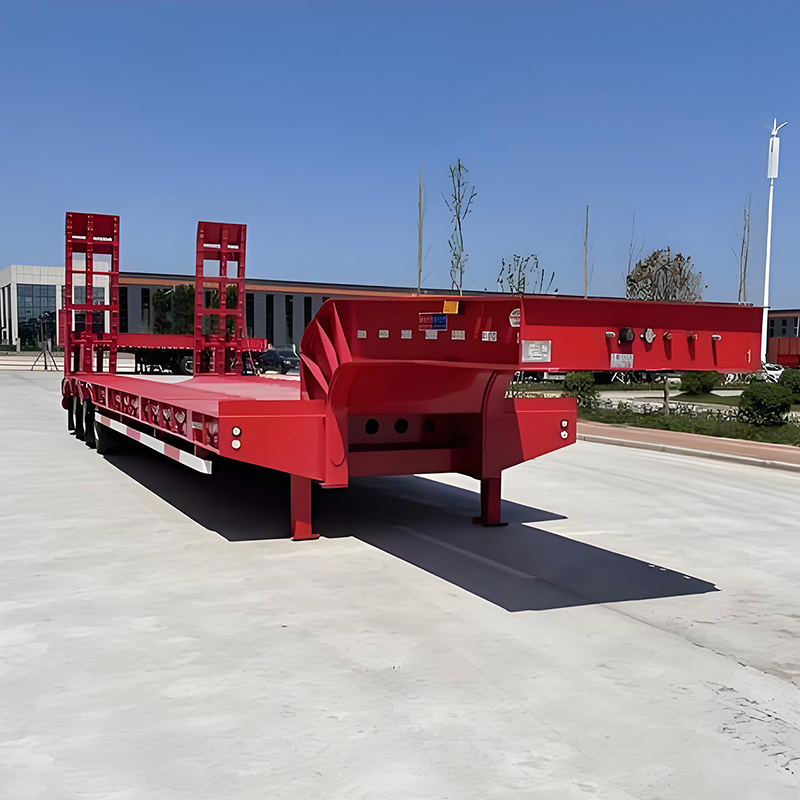
Lowering the center of gravity improves rollover stability immensely. A standard Lowbed Semi Trailer often features a deck height ranging from 400mm to 1200mm. A lower deck allows you to haul taller equipment without striking overpasses or violating height restrictions. However, lowering the deck requires specialized tire selection. You cannot fit standard commercial tires under a low deck. You must equip the trailer with low-profile variants, such as 12R22.5 or 235/75R17.5.
Choosing the right gooseneck style drastically changes operational workflows. A Fixed Gooseneck (FGN) provides a lighter, simpler frame. However, loading tracked equipment requires heavy rear ramps. These rear ramps add significant weight to the rear axles.
A Removable Gooseneck (RGN) adds mechanical complexity and a slight upfront weight penalty at the front. Yet, it entirely eliminates the need for heavy rear ramps. This trade-off partially offsets the tare weight. More importantly, an RGN allows for much safer front-loading. Operators can drive heavy excavators directly onto the deck from the ground.
Fleets transporting exceptionally long assets face unique dimensional challenges. Wind turbine blades and precast concrete beams require extreme length. Designing a telescoping, extendable deck provides necessary dimensional flexibility. When retracted, the trailer operates normally. When extended, it accommodates massive lengths. Engineers must carefully design the overlapping beam structure. It must handle extreme sheer stress when fully extended without bending.
Engineering a trailer to hold 100 tons in a factory is easy. Ensuring it can legally transport that weight down a public highway is the real challenge. You must align structural strength with legal reality.
Many buyers confuse gross weight with payload capacity. The calculation is strict and unforgiving. Your maximum legal payload equals the legal GVWR limit minus the tractor weight and the trailer tare weight. If your trailer frame is overly heavy, your legal payload drops proportionately. You must scrutinize the unladen weight of your tractor and trailer combination before committing to a heavy haul.
Legal loading capacity is dictated by regional highway regulations. Structural strength alone does not grant highway access. Regulations like the US Federal Bridge Formula limit the weight a single axle group can place on infrastructure. Typically, regulations cap weight at 20,000 lbs per single axle. Spacing your axles further apart allows you to carry more total weight legally. Engineers must design the axle spread to exploit these bridge formulas effectively.
We highly recommend utilizing load-planning software during the design and procurement phase. Do not guess where the weight will sit. Software can simulate how specific heavy machinery will distribute weight. For example, placing a 50-ton dozer too far forward overloads the tractor's fifth wheel. Placing it too far back overloads the trailer's rear axles. Simulation software ensures your custom deck length accommodates proper load centering.
Purchasing a heavy haul asset requires rigorous vetting. You must hold manufacturers accountable to strict engineering standards. Use this criteria to evaluate your next build.
Before approving any custom design, demand proof of structural integrity. Require the manufacturer to provide Finite Element Analysis (FEA) stress-test reports. FEA uses computer modeling to simulate your specific heaviest load on the digital frame. It highlights stress concentrations and weak points in red. If a manufacturer refuses to provide FEA data, consider it a major red flag.
The strength of a trailer relies heavily on its moving parts. Do not accept generic, unbranded components in high-stress areas. Specify name-brand, proven components. Require WABCO or Knorr-Bremse braking systems for reliable stopping power. Mandate reputable axle brands known for heavy haulage durability. Ensuring component authenticity guarantees the physical capacity matches the theoretical engineering rating.
A custom trailer engineered with lighter, stronger steel usually carries a higher upfront price tag. However, you must evaluate the operational return on investment. Increased daily payload capacity means fewer trips for large projects. Furthermore, a lighter empty trailer reduces fuel consumption on return journeys. Focusing purely on the cheapest purchase price often leads to heavy, inefficient trailers that drain profitability over time.
Designing a lowbed semi trailer to handle more loading capacity requires an exacting balancing act. You must reduce the unladen weight, increase the structural yield strength, and adhere strictly to regional axle-weight regulations. Simply adding more steel bulk creates a heavy, non-compliant asset.
Prioritize manufacturers who lead with engineering transparency. Always ask for verifiable material certifications and stress-test data. A compliance-first design framework ensures your fleet stays profitable and legally sound on the highway. Your next step should be auditing your current fleet's tare weight and simulating your heaviest routine loads against regional bridge formulas.
A: GVWR (Gross Vehicle Weight Rating) includes the total weight of the trailer itself plus the cargo it carries. Payload capacity strictly refers to the weight of the actual cargo the trailer can legally and safely transport. To find your true payload, you must subtract the empty weight of the trailer from the GVWR.
A: The hydraulic mechanisms of an RGN add upfront tare weight to the trailer. However, this design eliminates heavy rear ramps, partially offsetting the weight penalty. More importantly, an RGN optimizes loading safety and speed, which often justifies the slight capacity trade-off depending on your operational needs.
A: Retrofitting an existing trailer carries severe risks. Structural limits are engineered directly into the main beam based on its original design. Adding extra axles later does not legally or safely increase the original steel frame's yield limit. It often leads to frame cracking and compliance violations.
A: Industry standards dictate keeping ramp angles below 15 degrees to prevent equipment damage and tipping. Ideally, you should aim for a loading angle closer to 8 degrees. A longer ramp or an RGN design helps achieve this safer, shallower angle for tracked machinery.