Views: 0 Author: Site Editor Publish Time: 2026-06-07 Origin: Site
Purchasing the wrong heavy-haul equipment carries massive operational stakes. You risk severe bridge clearance violations, main beam fractures from extreme point-loading, or wasting expensive diesel on unnecessary deadweight. A lowbed semi trailer is never a simple, one-size-fits-all commodity. It represents a highly customizable engineering category. Manufacturers design these specialized units specifically to solve strict height, weight, and loading environment constraints. Relying solely on basic marketing brochures often leads to critical fleet failures. This guide moves past surface-level specifications to examine actual performance metrics. We break down the specific functional classifications you must understand. You will discover essential structural material requirements and critical compliance calculations needed for safe transport. Heavy machinery demands uncompromising structural integrity and precise axle configurations. By mastering these core engineering variables, you can confidently specify the exact heavy-haul trailer your fleet needs to scale operations securely.
Many equipment buyers fall into a dangerous mathematical trap when evaluating trailer specifications. They read a manufacturer's brochure, spot a massive capacity rating, and assume it perfectly matches their heavy machinery. Gross Vehicle Weight Rating (GVWR) represents the absolute maximum weight the trailer can structurally support, including the trailer itself. You must always calculate the Net Carrying Capacity. To find your true payload limit, you subtract the trailer's empty weight from the gross rating. Failing to run this basic calculation often results in overloaded axles and severe structural strain.
Deadweight constraints play a massive role in your final payload yield. A standard lowbed trailer carries a substantial tare weight, usually ranging from 15,000 to 18,000 lbs. Every feature you add directly reduces your available legal payload. If you specify complex hydraulic detachment mechanisms, heavy-duty outriggers, or extra lift axles, you instantly increase the deadweight. A beautifully equipped trailer might look impressive on the lot, but it becomes a liability if it steals 4,000 lbs of net capacity away from your cargo allowance.
Furthermore, theoretical beam strength means nothing if you violate local jurisdiction rules. Regulatory constraints and per-axle weight limits dictate exactly what you can haul. Many regions enforce strict bridge laws. For example, some jurisdictions enforce a hard 10-ton limit per axle to protect aging highway infrastructure. These local laws legally dictate the number of axles you must order. Even if your main beam can easily support a 60-ton excavator, an inadequate axle configuration will trigger hefty highway fines and route restrictions. You must align your axle count with the strictest regulations along your primary transit routes.
Understanding the structural variations within this equipment category ensures you select the correct tool for your loading environment. Engineers separate these trailers into three distinct functional categories based entirely on how they articulate and load freight.
The Removable Gooseneck (RGN) serves as the gold standard for heavy construction logistics. The front neck physically detaches from the main deck and pulls away via the tractor. This action drops the front of the trailer deck flat onto the ground, creating a highly accessible, shallow ramp.
RGNs are best for drive-on heavy machinery. If your fleet frequently moves bulldozers, asphalt pavers, or heavy tracked excavators, this design prevents disastrous loading accidents. Equipment operators can safely drive machinery over the front without navigating steep rear angles.
Buyers must choose between hydraulic and mechanical RGN systems. Hydraulic RGNs utilize integrated cylinders to detach the neck quickly. They allow for fast, adjustable ride-height changes during transit to clear uneven railroad crossings. However, they require a tractor equipped with a wet kit or a separate pony motor mounted on the neck, meaning higher maintenance demands. Mechanical RGNs operate without fluids or pumps. They weigh less and cost less upfront, but they are significantly harder to detach on uneven dirt job sites.
Unlike the RGN, a Fixed Gooseneck (FGN) features a neck securely welded or bolted to the main deck. The deck still drops down behind the tractor to provide critical height clearance, but it offers zero front articulation. Because the front remains fixed, operators cannot drive machinery onto the trailer from the front. Loads must be driven on from the rear or dropped in from above.
Rear loading requires extremely long, heavy-duty ramps to reduce the approach angle. FGN units excel in fleets utilizing dedicated rear-loading bay infrastructure. They also dominate the transport of crane-loaded static freight, such as large industrial generators or heavy steel coils. By eliminating the heavy detachment mechanics, FGNs provide a slightly higher net payload capacity compared to an RGN of the same size.
The rigid fixed-neck variant offers absolutely no front articulation and often lacks the pronounced dual-drop "well" seen in traditional designs. These models represent the most basic structural approach.
They are best for fleets prioritizing the lowest possible tare weight and acquisition cost. You strictly reserve these trailers for loads capable of easy side-loading via forklifts or direct drop-loading via overhead gantry cranes. They strip away mechanical complexity to maximize pure cargo payload efficiency on controlled, predictable routes.
| Trailer Type | Primary Loading Method | Best Suited Cargo | Key Advantage |
|---|---|---|---|
| Removable Gooseneck (RGN) | Front (Drive-on) | Tracked excavators, bulldozers, pavers | Safest, lowest approach angle for machinery |
| Fixed Gooseneck (FGN) | Rear (Ramps) or Top (Crane) | Static freight, crane-loaded industrial parts | Higher payload yield, zero hydraulic maintenance |
| Fixed-Neck (Rigid) | Side (Forklift) or Top (Crane) | Palletized heavy freight, steel plates | Lowest tare weight, lowest acquisition cost |
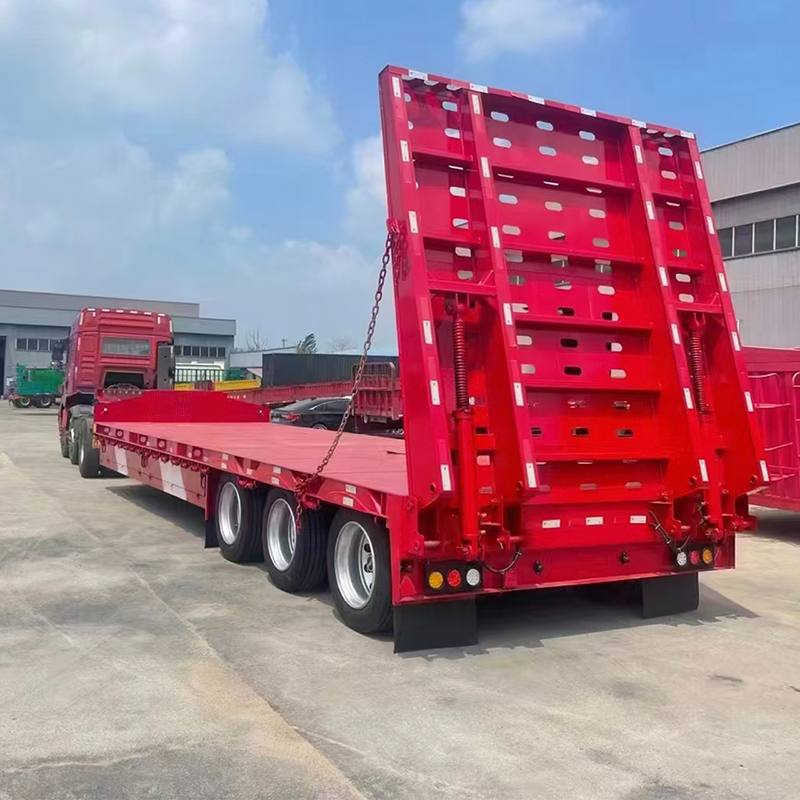
Specifying the physical dimensions of your lowbed semi trailer requires precise measurements of your largest standard cargo. The "well" refers to the flat lower deck space positioned directly between the gooseneck drop and the rear wheel drop. This section carries the bulk of your heavy payload.
Standard well lengths typically run from 24 feet up to 29.6 feet. Buyers must rigorously measure their machinery's exact track length or wheelbase. If your tracked excavator's footprint exceeds the well length, the tracks will rest on the angled transitions. This creates a severe safety hazard and places immense stress on the trailer frame. Always order a well length slightly longer than your maximum track footprint.
Height clearance stands as the primary reason fleets invest in this equipment. The signature 18-inch ground clearance of the lower deck provides a massive logistical advantage. Sitting just a foot and a half off the asphalt allows for the legal transport of freight reaching up to 11.5 or even 12 feet tall. This deep drop keeps the overall load height safely underneath standard highway bridge limits, avoiding costly detours and specialized high-load escort vehicles.
Multi-axle scaling dictates your maximum legal weight limit. You cannot simply stack weight onto a reinforced frame; you must distribute it across the pavement.
The steel grade dictates the survival of your trailer. When transporting multi-ton earth-moving equipment, material selection separates commercial-grade tools from dangerous liabilities. The "Us vs. Them" test in the heavy-haul market always comes down to metallurgical yield strength.
You must instruct your procurement team to reject standard Q345 steel for heavy excavator transport. While Q345 works adequately for standard flatbeds moving palletized goods, it fails under the extreme point-loading of tracked machinery. High-yield strength HG60 steel should serve as your minimum acceptable standard. HG60 resists catastrophic beam snapping and severe torsion when a 50-ton machine drives over the deck.
Beam dimensions matter just as much as the steel grade. A durable lowbed semi trailer should feature a robust 500mm main beam height paired with a 300mm width. Many budget manufacturers cut costs by utilizing narrow 140mm width beams. These cheaper, narrower beams suffer roughly 20% less torsion resistance. When navigating uneven job sites, a 140mm beam will twist, eventually leading to microscopic weld fractures.
Your loading ramps and decking materials take severe abuse daily. Ramps must be forged from T700 high-strength steel. Heavy steel tracks act like massive metal cleats; they will quickly deform and bend standard steel ramps. Regarding flooring, operators constantly debate between wood and steel. Wood floors, typically thick hardwood, allow for heavy-duty nailing and customized blocking of awkward freight. Steel plate flooring proves incredibly durable against gouging, but it becomes dangerously slippery in wet environments and prevents operators from nailing down timber blocks.
Finally, inspect the trailer's pre-camber. An empty trailer should never sit perfectly flat. Quality engineers build a slight upward arch (camber) into the main beams. When you load 40 tons of machinery onto the deck, the arch flattens out, ensuring the deck remains level during transit. Without pre-camber, the trailer will sag permanently under load. Additionally, ensure the manufacturer applies adequate galvanization or protective zinc coatings, especially where differing metals meet, to prevent aggressive electrochemical corrosion over time.
| Specification Feature | Budget Trailer Standard | Heavy-Haul Required Standard |
|---|---|---|
| Main Beam Steel Grade | Q345 (Prone to point-load failure) | HG60 (High yield, prevents snapping) |
| Main Beam Dimensions | 140mm Width | 300mm Width (Improves torsion resistance 20%) |
| Loading Ramp Material | Standard Carbon Steel | T700 High-Strength Steel |
| Deck Structural Profile | Flat deck (Prone to permanent sagging) | Engineered Pre-Camber (Flattens evenly under load) |
Navigating dozens of spec sheets becomes overwhelming without a structured approach. Use this rapid decision tree to pinpoint the exact trailer configuration your fleet requires.
Buying the correct heavy-haul trailer requires a rigorous exercise in balancing tare weight, legal axle limits, and steel yield strength. Every additional feature subtracts from your legal payload capacity. Over-specifying a trailer adds unnecessary deadweight, reducing your daily profitability. Conversely, under-specifying your steel grade or axle count causes catastrophic beam failure and invites severe regulatory fines. You must align your well length, deck height, and HG60 steel requirements with the physical realities of your machinery. We strongly prompt you to consult with our engineering and sales team today. Bring your specific payload dimensions, maximum weights, and route restrictions to our experts so we can provide a mathematically sound, spec-matched quote tailored entirely to your fleet.
A: Because the specialized lower deck sits roughly 18 inches off the ground, operators can typically haul freight between 11.5 and 12 feet tall. This deep drop allows the entire load to remain legally under the standard 13.5 to 14-foot US federal bridge height limits without triggering oversize restrictions.
A: Step-decks feature only one drop directly behind the tractor, leaving the entire remaining rear deck completely flat. Lowbeds feature two distinct drops—one behind the gooseneck and one just before the rear wheels. This dual-drop design creates a recessed "well" specifically engineered for maximum vertical freight clearance.
A: Engineers design this upward curve, known as pre-camber, directly into the heavy-duty main beams. It acts as a structural countermeasure. When operators load 40 or more tons of machinery into the well, the immense weight pushes the arch down, ensuring the deck rides perfectly flat during high-speed transit.